Sea turtle myths most visitors believe (and what's actually true)

Every evening on the beach south of Puerto Escondido, guides hear the same questions. Will the mother come back for them? Can they hide inside their shell? Is it true they cry? Most of what people "know" about sea turtles comes from cartoons, aquarium gift shops and half-remembered documentaries, and some of it is simply wrong. Here are the myths we hear most often, and the sea turtle facts behind them.
Myth 1: Sea turtles can pull their head inside their shell
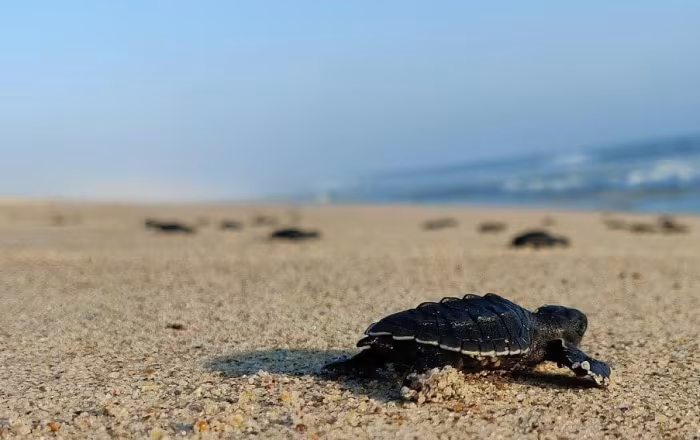
Land turtles and many freshwater turtles can. Sea turtles can't. Their head and flippers stay outside the shell all the time, which is one of the trade-offs of a body built for swimming: a flatter, lighter shell and long, paddle-shaped flippers instead of a fortress. It's also why a hatchling in your hands looks so exposed. It has no way to hide, only speed.
A related myth is that a turtle can leave its shell. It can't, at any age. The shell is part of the skeleton, fused to the spine and ribs, and it grows with the turtle for its whole life.

Myth 2: The mother waits for her babies, or comes back for them
She doesn't. A nesting female digs her chamber, lays around a hundred eggs, covers them, and returns to the sea within an hour or so. She never sees her young. Hatchlings dig themselves out together about two months later and head for the water on their own instincts. There is no parent on the beach to guide them, which is part of why protected hatcheries make such a difference. If you want to know what happens during those two months, we explain it in our guide to turtle nests and incubation.
Myth 3: Turtles cry when they lay their eggs
Watch a nesting turtle and you'll often see thick tears running from her eyes. It looks emotional, and the story that she is "crying" for her eggs is told on many beaches. In reality, those tears come from glands near the eyes that remove excess salt. Sea turtles drink seawater and eat salty food, and the glands work all the time; you just notice it on land, where the tears don't wash away. They also help keep sand out of her eyes while she digs.
Myth 4: Most hatchlings make it
Sadly, no. The odds are long for every baby turtle. Crabs, birds and dogs take some on the beach; fish and other predators take many more in the first hours and days at sea. Nobody can count them precisely, so estimates vary a lot: you'll see figures anywhere from about 1 in 100 to 1 in 1,000 reaching adulthood. What's clear is that sea turtles survive as species by producing huge numbers of eggs, and that every human threat on top of natural ones (lights, plastic, nets, poaching) tips a fragile balance. We cover those threats in detail in what threatens sea turtles in Oaxaca.
Myth 5: You should carry the hatchlings into the water to help them
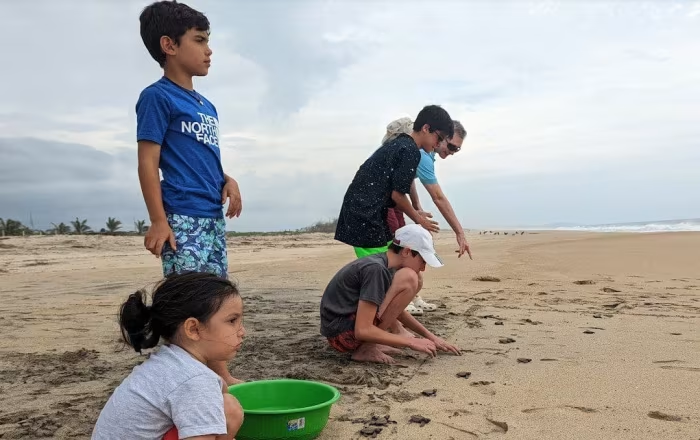
It feels kind, but it's the opposite of help. Hatchlings are placed on the sand a short distance from the water and crawl the rest of the way themselves. Scientists believe that crawl, together with the first swim, helps them register where they are, using cues such as the Earth's magnetic field, and that this helps females find their way back to the same region to nest years later. The crawl also wakes up their muscles for the frantic swim through the surf. Your job is to stand back, keep your shadow and your feet out of their path, and let them go.
The same goes for "rescuing" a slow hatchling, turning one over or rinsing sand off it. If something looks wrong, tell the guide. On the release, the team decides when and how the turtles are handled.
Myth 6: Turtle eggs are an aphrodisiac
This belief kept the illegal egg trade alive on the Mexican coast for decades, and there is no evidence for it at all. What is real is the law: Mexico banned the capture of sea turtles and the trade in their eggs in 1990, and taking or selling them is a federal crime. If someone offers you turtle eggs, meat or shell jewelry, the only right answer is no. The story of how coastal towns moved from that trade to protection is told in from hunting to protection in Mazunte.
Myth 7: Females always return to the exact beach where they hatched
Partly true, and a lot more interesting than the myth. Females do tend to come back to the region where they hatched, a behavior called natal homing, often after ten years or more at sea. But "the exact beach" is too strong. Olive ridleys, the species you'll release here, gather in huge numbers on a few beaches like La Escobilla, yet many also nest alone along other stretches of the coast. Think of it as returning to the neighborhood, not to the same grain of sand.
Myth 8: There are so many olive ridleys here that they're no longer at risk
It's easy to think so when you hear that a single beach can receive hundreds of thousands of nests in a good season. The olive ridley's recovery on this coast is a genuine conservation success, built on the 1990 ban, beach patrols and hatcheries. But it is still listed as Vulnerable on the IUCN Red List and is protected under Mexican law, and most of its numbers depend on a handful of nesting beaches. A recovery that relies on a few places and constant protection is a recovery worth keeping an eye on. Learn more about the species in our guide to the olive ridley, or see how it's assessed by NOAA Fisheries.

Myth 9: A flash photo or a bit of light doesn't matter
It does. Hatchlings find the ocean by heading toward the brightest, lowest horizon, which on a natural beach is the sea reflecting the sky. A camera flash, a phone torch or a beachfront bar can pull them the wrong way or leave them confused and exhausted. That's why the release happens in natural light at sunset and why flash photography is not allowed on the tour. Switch the flash off before you arrive; you'll still get beautiful pictures in the golden light.
Is it true that turtles live more than 100 years?
Nobody really knows. Sea turtles are hard to follow through their whole lives, and their age can't be read from the outside. What researchers do know is that they grow slowly and take many years to mature; for olive ridleys, estimates usually fall somewhere in the teens. Claims of 100-year-old sea turtles make a good story, but you'll rarely find solid evidence behind them.
Why the myths matter
Some of these myths are harmless. Others, like carrying hatchlings to the water or believing eggs have special powers, directly hurt turtles. The good news is that the real biology is more impressive than any legend: a palm-sized animal that digs out of the sand with its siblings, crosses the beach in the dark or at dusk, and swims into the open Pacific alone. When you kneel on the sand at sunset and watch one go, you'll know exactly what it's up against. Before your release, our tips for families and first-timers will help you make the most of the evening.