Turtle release or night nesting watch: what's the difference?

Search for a turtle nesting tour in Oaxaca and you'll find two very different experiences sold under similar words. One is a hatchling release: you go to the beach in the late afternoon and help baby turtles from a protected hatchery reach the sea. The other is a night nesting watch: you walk a dark beach hoping to see an adult female dig her nest and lay her eggs. Both are about the same animals and the same beaches, but they differ in timing, season, what you're likely to see and who they suit. Here's an honest comparison so you can pick the right one for your trip.
The short version
- Hatchling release: late afternoon to sunset, a couple of hours, possible all year on this coast, and you take part directly. You see babies, not adults.
- Night nesting watch: late at night, often a long wait, mainly in nesting season, and you only watch from a distance. When it works you see an adult turtle laying eggs; some nights you see nothing.
They're two ends of the same story. The eggs laid on nesting nights are collected by conservation teams, incubated for roughly 45 to 60 days, and the hatchlings that emerge are the ones released at sunset.

What happens on a hatchling release
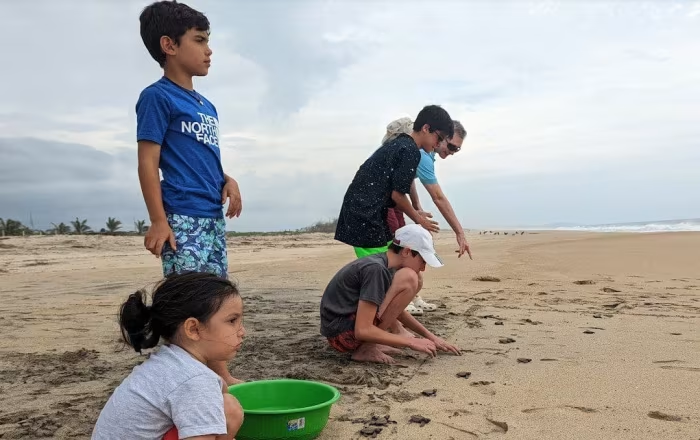
Our tour is a release, so this is the one we can describe in detail. We pick you up at your hotel or Airbnb in Puerto Escondido at 4:30 PM and drive about 30 minutes south to Playa Escobilla, a protected nesting beach. At the hatchery, the conservation team shows you nests at different stages of incubation and explains how the eggs got there. Then, as the sun goes down, you receive your hatchlings, walk to the waterline and let them go. You're back at your hotel around 7:00 PM.
The species is almost always the olive ridley, the most common sea turtle on the Oaxacan coast; now and then leatherback hatchlings are released too. Because hatchlings are released when they emerge naturally, the number you hold depends on what hatched that day, but you can usually release several.
The rules are simple: no flash, no chasing the hatchlings, watch where you step and follow the guide. If you want to know what separates a good release from a bad one, read is a turtle release ethical?
What happens on a night nesting watch
A nesting watch is about adult females, which come ashore mostly at night. A guide or a community patrol walks the beach, usually without white light, and when a turtle is found the group waits at a distance until she has started laying. At that point she's less likely to be disturbed, and visitors may be allowed to approach quietly from behind to watch, sometimes under a dim red light.
A few things are worth knowing before you book one:
- There's no guarantee. Turtles don't keep a schedule. You can walk for hours and see nothing, or see several in one night.
- It's late. Activity often peaks well after dark, so expect to be out late, on soft sand, with little light.
- It's seasonal. On this coast, olive ridleys nest mainly from about July to December, with the busiest months in most years between August and November. Outside that window the chances drop a lot.
- Sanctuaries limit access. Playa Escobilla is a federal turtle sanctuary, and during an arribada the nesting zone is restricted to protect the turtles. Mass nesting is not a show you can buy a ticket for; we explain why in what is an arribada?
We don't run night nesting tours, and we won't promise you'll see adult turtles on our release. If someone offers you guaranteed nesting sightings on any night of the year, treat that as a red flag.
Side by side
Timing
The release fits into an ordinary vacation day: you're back for dinner. A nesting watch eats into the night and often the next morning, which matters if you have an early surf lesson or a long drive the next day.
Season
Releases happen year-round on the Puerto Escondido coast, because there are hatchlings to release in every month. Nesting watches depend on the nesting season. Our month-by-month turtle season guide shows what each part of the year looks like.
What you see and do
On a release you're hands-on: you hold the container, you set the hatchlings down, you watch them reach the surf. On a nesting watch you're an observer, and a good one stays still, quiet and behind the turtle the whole time. The payoff is seeing an animal that can be decades old do what her species has done for millions of years.
Photos
Neither allows flash. At a sunset release there's still natural light, so phone photos usually come out fine. A nesting watch happens in near darkness, and most guides ask you to keep phones and cameras away while the turtle is on the beach. Go for the experience, not the picture.
Children
The release works very well for kids: short, early, and they get a real job to do. Night nesting walks are harder for small children because of the hour, the waiting and the need to stay silent. Our guide to turtle releases with kids has practical tips for families.
Is one better for the turtles?
Both can be done well or badly. A good release uses hatchlings that emerged that day or the night before, lets them walk to the water on their own and doesn't use the same spot every evening. A good nesting watch keeps groups small, uses no white light, keeps people behind the turtle and lets the patrol decide when and how close you go. In both cases, the people running it should be able to tell you who manages the beach and what happens to the eggs.
What hurts turtles is the same either way: bright lights on nesting beaches, crowds around a female who hasn't started laying, people handling animals for photos, and the illegal trade in eggs, which has been banned in Mexico since 1990.

Can you do both?
Yes, if your dates fall in the nesting season and you find a responsible operator for the night walk. Many travelers do the sunset release first, since it's easy to plan, and decide afterward whether the late-night option is worth it. Outside the season, the release is the realistic choice on this coast.
And even if you never book a nesting watch, you may meet a nesting turtle on your own on an evening walk. If that happens, keep your distance, stay behind her, don't shine any light and let a local patrol know. Our article on how travelers can help sea turtles covers the rest of the small things that make a difference.