Inside a turtle nest: incubation, sand temperature and the sex of hatchlings

The hatchling you release at sunset spent roughly two months underground before it ever saw the sky. Those weeks under the sand decide a lot: whether the egg hatches at all, how strong the little turtle is when it reaches the surface and, surprisingly, whether it is male or female. Here is what goes on inside a sea turtle nest on the Oaxacan coast.
How a nest is built
A nesting olive ridley crawls above the high-tide line, clears a shallow pit with her front flippers and then digs the egg chamber with her back flippers, scooping sand one side at a time. The chamber is shaped a bit like a flask: a narrow neck that opens into a wider room, usually somewhere around 35 to 50 centimeters below the surface. That is as deep as her back flippers can reach.
She lays around a hundred eggs, each about the size of a ping-pong ball, with a soft, leathery shell that gives slightly instead of cracking. Then she fills the hole, packs the sand down and throws sand around to hide the spot before heading back to the sea. She never returns to check on it. From that moment, the sand does all the work.

How long do turtle eggs incubate?
On this coast, olive ridley eggs usually hatch after roughly 45 to 60 days. The exact time depends mostly on temperature: in a warm nest the embryos develop faster and hatch sooner, while a cooler or rain-soaked nest can take noticeably longer. That's why hatcheries mark every nest with the date it was laid, and why the team can predict, within a few days, when each clutch should emerge.
Moisture and air matter too. The eggs breathe through their shells, exchanging oxygen and carbon dioxide with the air trapped between grains of sand. Sand that is too wet, too compact or flooded by a high tide can suffocate a clutch, and sand that is bone dry can dry out the eggs.
Turtle nest temperature and the sex of hatchlings
Sea turtles have no sex chromosomes the way humans do. Instead, the sex of each hatchling is set by the temperature of the sand during incubation, a system biologists call temperature-dependent sex determination.
- Warmer nests produce mostly females.
- Cooler nests produce mostly males.
- Around a middle value, often called the pivotal temperature, a nest produces a mix of both. For most sea turtle species it sits close to 29 °C.
The range between "all males" and "all females" is narrow, only a few degrees. And it is not the whole two months that counts: sex is decided during a sensitive window around the middle third of incubation. A heat wave or a week of heavy rain at that moment can tip a whole clutch one way or the other.
There's also a twist that surprises most visitors. Developing embryos produce heat of their own, so in the second half of incubation a large clutch can run a degree or two warmer than the sand around it. The center of a nest can produce more females than the edges.
Too hot, too cold
Temperature doesn't only decide sex. Outside a comfortable band, eggs simply fail. Very cool sand slows development until embryos stop growing, and sand that stays above roughly 32 to 33 °C for long periods kills them or produces weaker hatchlings that are smaller and slower to swim. A healthy nest lives in a fairly narrow window, and on a hot tropical beach in the dry season the sand can drift toward the top of it.
What a hatchery does about it
This is where the people you meet on the tour come in. When conservation teams move eggs from the open beach to a protected hatchery, they try to recreate the conditions of a natural nest, and good teams pay close attention to heat:
- They move eggs quickly. Eggs are usually relocated within a few hours of being laid, before the embryo settles against the inside of the shell and becomes sensitive to being turned.
- They copy the natural depth and shape of the chamber, using clean sand from the same beach.
- They space nests apart so clutches don't heat each other up.
- They use shade where needed. Many hatcheries put up shade cloth over part of the nests in the hottest months to keep temperatures in a healthy range and avoid producing only females.
- They mark and watch every nest with its date, so they know when hatching is due.
On the group release at Playa Escobilla, your guide walks you through the hatchery and shows you nests at different stages of incubation. It's a good moment to ask how they handle the hot months; teams that care about these details are usually happy to explain.
Hatching and the climb to the surface
When it's ready, each hatchling breaks the shell with a tiny, temporary point on its snout called an egg tooth. It then rests for a while inside the chamber, absorbing the last of its yolk, which will feed it through its first days at sea.
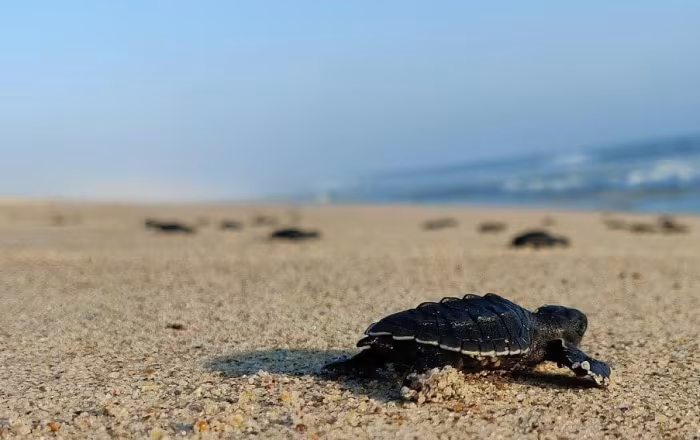
Digging out is a team effort. The hatchlings of a clutch work together over a few days: the ones on top scrape sand from the ceiling, it falls to the bottom and the whole group rises little by little. They usually wait just below the surface until the sand cools, which is why natural emergences often happen in the evening or at night, when the beach is cooler and there are fewer predators. Releases are timed around sunset for the same reason.

Can you tell if a hatchling is male or female?
No. Hatchlings look identical on the outside, and even the guides can't tell which of the turtles in your hands are boys or girls. Differences only appear years later, as the turtles approach maturity: adult males develop a much longer tail. Researchers who study nest sex ratios estimate them from sand temperatures or by examining hatchlings that died naturally in the nest, not by looking at live ones.
Why warming sand is a concern
Because the system depends on temperature, warmer beaches mean more females. A few extra females is not a problem in itself; one male can mate with several females. But the margin is small. A 2018 study of green turtles on Australia's northern Great Barrier Reef found that more than 99% of the young turtles coming from its warmest nesting beaches were female. Scientists are watching other nesting regions, including the Mexican Pacific, for similar trends, and that's one reason careful hatchery management matters: shading, spacing and nest placement are some of the few tools teams have to keep a balance.
Nature has some flexibility too. Turtles nest across many months and many beaches, so cool rainy-season nests and nests laid lower on the beach help balance hot dry-season clutches. Most years, the mix holds. The point of the hatchery work is to keep it that way.
What this means for your release
When you kneel on the sand at sunset, the turtles you hold have already passed their hardest test: two months in a warm, dark chamber with just the right amount of heat, air and moisture. Knowing that makes the short crawl to the water feel even more important. To see where these nests come from in the first place, read our guide to the arribada at La Escobilla, or learn more about the species in our guide to the olive ridley.