Where do baby sea turtles go after they hatch? The lost years

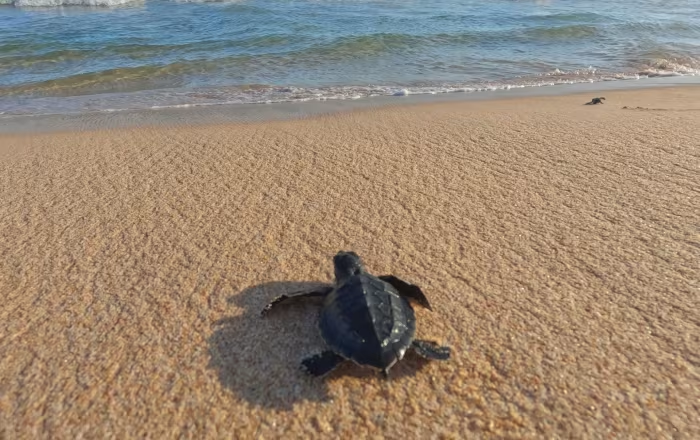
The last thing you see at a turtle release is a small dark shape disappearing into a wave. And then nothing. That hatchling won't be seen near a beach again for years, and for a long time nobody really knew where it went. Biologists even gave this stretch of a sea turtle's life a name, the "lost years", a phrase made popular by the sea turtle scientist Archie Carr. Here's what we know today about where baby sea turtles go after they hatch, and what is still a bit of a mystery.
The short answer
After they reach the water, baby sea turtles swim straight out to sea for about a day, then spend their first years drifting and feeding in the open ocean, far from the coast. They tend to gather where currents meet and floating seaweed, foam and debris collect, because that's where they find food and some cover. Depending on the species, they later move to coastal feeding grounds or stay oceanic most of their lives. Females come back to nest on the coast where they hatched, or close to it, once they reach adulthood, more than a decade later.
Day one: the swim frenzy
The trip starts with a sprint. As soon as a hatchling hits the surf, it swims almost nonstop for roughly 24 hours, a burst biologists call the "swim frenzy". It doesn't need to eat yet: it's running on the yolk left in its belly from the egg. The aim is simple, to get away from the shallow water near the beach, where predatory fish and seabirds hunt, as fast as possible. If you want to know how it keeps the right heading in the dark, we explain the light, wave and magnetic cues in how baby sea turtles find the ocean.
After the frenzy, the pace drops. The young turtle swims less, rests more at the surface and starts letting the currents do some of the work.
The open ocean: life in the drift lines
Out at sea, the ocean isn't uniform. Where currents meet, they leave long lines on the surface where everything that floats piles up: seaweed, foam, wood, small animals and, sadly, plastic. These drift lines and floating mats are the nursery of most young sea turtles. A turtle the size of your palm can rest there, hide from some predators and find food without having to dive.
What do they eat? Mostly small things floating near the surface: jellyfish and other soft-bodied animals, tiny crabs and shrimp, fish eggs and bits of algae. In the Atlantic, scientists have found young turtles closely tied to floating sargassum seaweed. In the Pacific, they seem to use whatever floats in the convergence zones. Staying at the surface also has a benefit people rarely think about: the sun warms them, which may help them grow faster.
Why they were "lost" for so long
For decades, the problem was practical. A hatchling weighs about as much as a couple of coins, far too little to carry a tracking device, and nobody can follow a tiny turtle across thousands of kilometers of open sea. Fishermen and researchers would see small juveniles now and then, but the gap between the beach and the first sightings of bigger turtles was mostly guesswork.
That has changed slowly. Genetic studies have linked juveniles found at sea to the beaches they came from. In one well-known case, young loggerheads feeding off Baja California turned out to have hatched in Japan, which means they had crossed the whole Pacific. More recently, very small solar-powered tags have let researchers follow some young turtles for weeks or months. Each new study fills in part of the map, but for most species and most beaches, including ours, the early years are still only partly understood.
Where Oaxaca's turtles end up
Each species takes a different path once it's past the first years:
- Olive ridleys, the hatchlings you release near Puerto Escondido, are among the most oceanic of all sea turtles. In the eastern Pacific they seem to roam widely across the open tropical ocean for most of their lives, often seen resting at the surface or around floating logs, rather than settling in one feeding area. Adult females then return to nest along this coast, sometimes all together in the mass nestings called arribadas. You can read more about them in our guide to olive ridley sea turtles.
- Leatherbacks are built for deep, open water and keep traveling enormous distances all their lives. Tracking of adults that nest on the Mexican and Central American Pacific coast has shown long journeys toward the southeastern Pacific. More in our post on leatherback turtles in Oaxaca.
- Green turtles usually leave the open ocean after their first years and move to coastal waters, where they switch to a diet of seagrass and algae in bays and lagoons.
So when you let your hatchling go, the honest picture is this: it's heading for a long trip through open water, most likely far from Oaxaca, and if it's a female and it survives, it will probably return to this coast to nest one day.
How long until they come back?
A long time. Sea turtles grow slowly, and most species need more than a decade to reach adulthood. Olive ridleys mature at around 14 years of age, according to NOAA Fisheries; leatherbacks and green turtles can take longer. When they're ready, females return to nest on the same region where they hatched, an ability that scientists link to a magnetic "memory" of their home beach. Males usually don't come ashore at all; they mate with females in the waters off the nesting beaches.
That's one reason the work on these beaches is a long game. A conservation team protecting nests today won't see the result for many years, when the hatchlings of this season come back as adults.
What happens to them along the way
Most hatchlings don't make it through the lost years. Fish, seabirds and sharks take many in the first months, and survival only improves as turtles grow too big to swallow. We go through the numbers, and why estimates vary so much, in how many baby sea turtles survive.
The drift lines that feed young turtles also collect plastic, and a turtle that eats whatever floats can't always tell a piece of a bag from a jellyfish. Older juveniles and adults also face fishing nets and longlines, boat strikes and, in some places, illegal hunting. We cover these in detail in what threatens sea turtles in Oaxaca.
What you can do
- Cut down on single-use plastic, on the beach and at home. Much of what ends up in the ocean ends up where young turtles feed.
- Pick up trash on the sand before the tide does.
- Choose seafood from responsible fisheries when you can, since bycatch is one of the main threats to older turtles.
- Support local conservation teams, which protect the one stage of a turtle's life that people can really control: the nest and the beach.
For more simple, practical ideas, read how travelers can help sea turtles.