How do baby sea turtles find the ocean? Light, slope, waves and magnetism

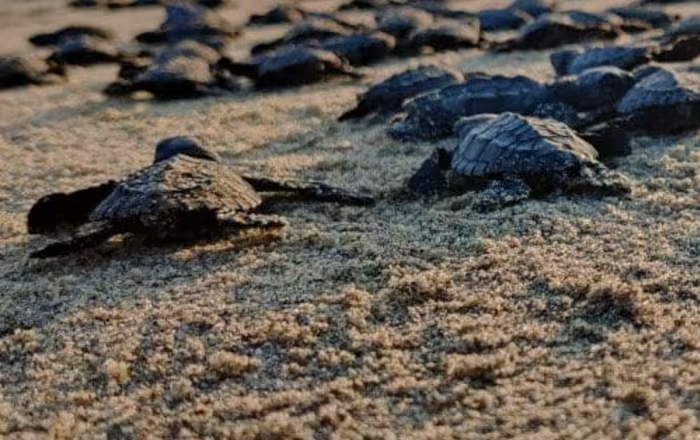
A hatchling digs its way out of the sand, pauses for a second, and then sets off in a straight line toward water it has never seen. If you've watched a release, you've probably wondered how it knows where to go. There's no mother to follow and no map. What it has instead is a short list of built-in rules, and each one works at a different stage of the trip: on the sand, in the surf and far out at sea.
The short answer
On the beach, baby sea turtles find the ocean mainly by light: they crawl toward the brightest, lowest horizon, which on a natural beach is the open sky over the water. They also tend to move away from tall, dark shapes like dunes and trees, and down the slope of the beach. Once they reach the water, they swim into the waves, which leads them offshore. Farther out, they appear to use the Earth's magnetic field to hold their course. None of this is learned. They're born with it.
On the sand: following the brightest horizon
Hatchlings usually leave the nest at night or at dusk, when the sand has cooled. Even on a dark night, the sky above the sea is a little brighter than the land behind the beach. Starlight and moonlight spread across an open horizon and bounce off the water, while the land side is blocked by vegetation, dunes and hills. A hatchling's eyes are tuned to pick up that difference, and they are especially sensitive to shorter wavelengths of light, the blues and greens.
Researchers have found that hatchlings compare brightness over a wide field of view rather than fixing on a single point. They also react to shape: a low, flat horizon pulls them in, a high, dark silhouette pushes them away. On a natural beach, both cues point the same way, to the sea. Slope seems to help a little too, but light and shape do most of the work.
You can often see the rules in action at a release. A hatchling may pause, lift its head, turn a few degrees, and then commit. That isn't confusion. It's the turtle scanning the horizon before choosing a direction.
What about the moon?
A common idea is that baby turtles "follow the moon" to the sea. Not quite. The moon helps only because it makes the sky over the water brighter. Hatchlings aren't steering toward the moon itself, and they find the sea just as well on a moonless night, as long as the beach is dark. What they really follow is the overall glow of the horizon.
Why artificial light is such a problem
This is where people come in. A beach bar, a street lamp, a hotel floodlight or even a phone flashlight can be brighter than the natural sky over the sea. To a hatchling, that light looks like the way to the ocean. Turtles drawn inland can wander for hours, end up on roads, dry out in the morning sun or be taken by crabs, birds and dogs. Biologists call this disorientation, and it's one of the main reasons conservation groups ask beachfront buildings to keep their lights low, shielded or turned off during the nesting season. The Sea Turtle Conservancy has a good overview of the problem.
It's also why the tour asks you not to use flash. A sudden burst of light at sand level can pull a hatchling off course just as it's choosing its direction. If you want to come home with good pictures anyway, our turtle release photography tips show how to work with the natural evening light.
In the surf: swimming into the waves
Once a hatchling hits the water, light is no longer much use. Now it relies on the waves. Near the shore, waves roll in toward the beach, and hatchlings swim head-on into them. Each passing wave lifts and drops the turtle in a way it can feel, and by swimming against that motion it keeps heading out to sea. This works even underwater and in total darkness.
This is the start of the "swim frenzy", a burst of almost nonstop swimming that lasts about a day, fueled by the yolk left in the hatchling's belly. The goal is to get past the breakers and the near-shore waters, where predatory fish and seabirds hunt, as quickly as possible.
Offshore: a built-in magnetic compass
Out beyond the waves, there's no slope and no clear wave direction to follow. Research led by Kenneth Lohmann and colleagues at the University of North Carolina showed that hatchlings can sense the Earth's magnetic field, both its direction and its intensity, and use it to keep a steady heading. Older turtles seem to read the field as a kind of map, since its strength and angle vary from place to place across the ocean.
This ability probably also explains one of the most remarkable things sea turtles do. Years later, adult females return to nest on the same stretch of coast where they hatched, or close to it. The leading idea is that hatchlings register the magnetic "signature" of their home beach early on and use it to find their way back as adults. It's still an active area of research, so treat it as the best current explanation rather than a settled fact.
Why hatchlings walk to the sea on their own
All of this is why a responsible release looks the way it does. The hatchlings are set on the sand a few meters from the water and left to crawl the rest of the way. Nobody carries them into the waves. That short walk gives them time to read the horizon, wake up their muscles for the swim frenzy and, scientists believe, start registering the beach. Dropping a hatchling straight into the surf skips all of it. If you want to know what else separates a good program from a bad one, read is a turtle release ethical?
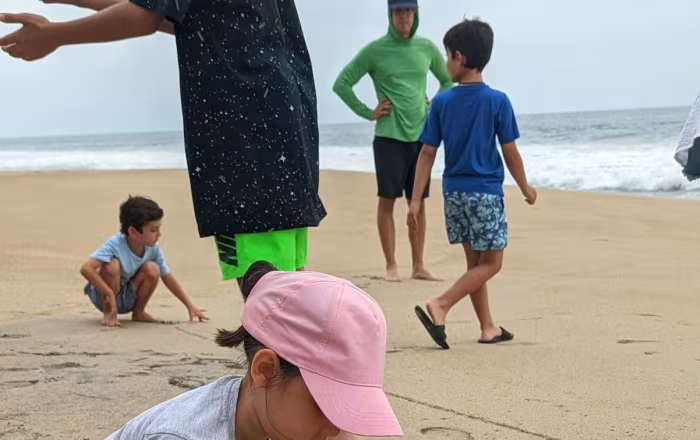
The release also happens at sunset, when the light is soft and the sand has cooled, and the group stands back from the hatchlings' path. Your shadow, your feet and your phone screen are all part of the landscape they're reading, so a little distance helps more than you'd think.
What you can do
- Keep the beach dark at night. If your room faces the sand, close the curtains after dark during the nesting season.
- No flashlights or flash near nests and hatchlings. If you need light to walk, use a dim red light and point it at your feet.
- Don't pick up or "guide" hatchlings. If you find one heading the wrong way, tell a local conservation team instead of carrying it to the water yourself.
- Fill in holes and flatten sandcastles before you leave. Hatchlings can get stuck in them on their way down the beach.
For more everyday ways to help while you travel, see how travelers can help sea turtles.
What happens after they reach the sea
Finding the ocean is only the first test. Most hatchlings won't survive to adulthood, and the reasons have little to do with direction. If you're curious about the odds, and about why protected nests still matter so much, read how many baby sea turtles survive.