Leatherback turtles in Oaxaca: the giant that nests on the Pacific coast

Most turtles you'll see near Puerto Escondido are olive ridleys, small and numerous. The leatherback is the opposite: the largest turtle alive, one of the rarest nesters on this coast, and a species whose Eastern Pacific population has fallen so far that every nest is counted. Oaxaca happens to hold two of the beaches that matter most for its survival. Here is what we know about the leatherback turtle in Oaxaca, where and when it nests, what went wrong, and what is being done about it.
A turtle built differently
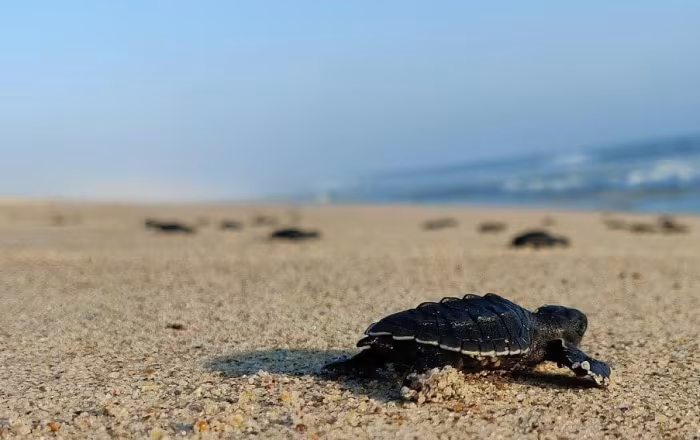
The leatherback (Dermochelys coriacea, tortuga laúd in Spanish) is the only living member of its family. According to CONANP's species fact sheet, its shell can reach 1.8 meters and females can weigh up to 500 kilos. Instead of hard plates it has smooth, leathery black skin speckled with white, with seven ridges running down the back. In Mexico it goes by many local names, including siete filos and siete quillas, both after those ridges.
A few details that make it stand out:
- A pink spot on the head. Each adult has a pinkish mark on top of the head that is unique to the individual, and researchers use it to recognize turtles.
- Deep diver. It dives mostly at night, on average around 300 meters, sometimes to about 1,000 meters, and can stay down for up to 45 minutes.
- Jellyfish specialist. It feeds on jellyfish and other soft, gelatinous animals, and has been observed eating more than 200 kilos of them in a day.
- The widest range of any reptile. Its feeding grounds are in cold water; Eastern Pacific leatherbacks that nest in Mexico head south after the season, toward the waters off Peru and Chile.
For a side-by-side comparison with the other species that live here, see our guide to Oaxaca's sea turtle species.

Where leatherbacks nest in Oaxaca
Leatherbacks have been recorded nesting on up to 61 beaches of the Mexican Pacific, but CONANP notes that about 45% of all annual nesting is concentrated on four index beaches, the ones monitored every season to track the population: Mexiquillo (Michoacán), Tierra Colorada (Guerrero), and two in Oaxaca, Cahuitán and Barra de la Cruz.
Barra de la Cruz – Playa Grande
East of Huatulco, Barra de la Cruz is now the best-known leatherback beach in the state. On January 8, 2024 it was decreed a federal protected area, the Barra de la Cruz – Playa Grande Sanctuary. Protection work there goes back decades and is carried out by CONANP, the organization Kutzari A.C., volunteers and two Chontal communities from the area. In the 2024–2025 season, CONANP reported 227 protected nests, about 93% of those laid, and 8,451 hatchlings released to the sea.
Cahuitán
Cahuitán lies at the other end of the Oaxacan coast, on the Costa Chica near the Guerrero border. It is smaller and less visited, and its nests are protected by field teams together with a community protection committee. Over the years it has been one of the four beaches whose counts tell scientists how the whole Mexican Pacific population is doing.
Closer to Puerto Escondido
CONANP also lists secondary nesting beaches in Oaxaca, including Chacahua, west of Puerto Escondido, and La Tuza. Historically, Chacahua was considered one of the most important leatherback beaches in the country. Today nesting near Puerto Escondido is occasional, which is why leatherback hatchlings only sometimes turn up at a release on Playa Escobilla.
When is leatherback season?
On Mexico's Pacific beaches, leatherbacks nest from October to March, with a clear peak in December and January. That is the reverse of what many visitors expect: the olive ridley's big months are in summer and autumn, while the leatherback is a winter nester.
Each female comes back to the beach several times in one season, laying on average five clutches, roughly ten days apart, and sometimes as many as eleven. A clutch holds about 62 eggs on average and incubates for around 60 days, so leatherback hatchlings emerge mostly between December and spring. Females don't nest every year; they usually skip two or three years or more between seasons, and they take an estimated 14 to 20 years to reach maturity. Our month-by-month guide shows how these dates overlap with the olive ridley calendar.
How far has the population fallen?
The numbers are stark. At Mexiquillo, researchers from Mexico's National University recorded 3,000 to 5,000 leatherback nests a year between 1982 and 1989. In the 1993–1994 season, nesting dropped sharply there, and the same drop was seen at Tierra Colorada, Chacahua and Barra de la Cruz. That alarm led to the creation of Proyecto Laúd in 1995, which now runs under CONANP and pools the data from all the main beaches.
By the 2008–2009 season, the four index beaches together recorded 413 nests: 69 at Mexiquillo, 192 at Tierra Colorada, 42 at Cahuitán and 110 at Barra de la Cruz, according to the project's report. CONANP's own fact sheet sums it up: despite about 30 years of continuous protection at beaches like Mexiquillo, the general downward trend had not been reversed. The Eastern Pacific leatherback is classified as critically endangered, and in Mexico it is listed as endangered under the official NOM-059 standard.

Why it declined
CONANP and the field teams point to several causes acting together:
- Egg poaching, intense for decades before turtle products were banned in Mexico in 1990, and still a problem on some beaches.
- Incidental capture in fisheries, here and along the migration route. In 2008–2009, every dead turtle found at Barra de la Cruz showed signs of fishing gear or propeller strikes.
- Loss of nesting habitat where beaches were developed for tourism or housing.
- Red tide events, which CONANP cites among recent mortality causes.
- Rising sand temperatures, a concern because a hatchling's sex depends on nest temperature.
Is it recovering?
It is too early to say. Protection rates at the index beaches are now very high, the Barra de la Cruz sanctuary gives the species legal protection it lacked before, and Proyecto Laúd keeps the beaches of Michoacán, Guerrero and Oaxaca working from the same data. But because females take well over a decade to mature, the results of today's work won't show up on the beach for many years. The honest answer is that every protected nest still counts.
Can you see a leatherback near Puerto Escondido?
Not reliably, and no one should promise you one. Nesting beaches like Barra de la Cruz are protected areas where night patrols work with as little disturbance as possible. If you happen to meet a leatherback on a beach at night, stay well back, keep lights and phones off, don't touch her or stand in front of her, and tell the local turtle camp or report it to the authorities.
What you can do is support the people protecting the nests, and the same habits that help every species help the leatherback too, especially keeping plastic out of the sea: a floating bag looks a lot like a jellyfish. If leatherbacks have caught your interest, it's worth comparing their story with the turtle that dominates this coast: read our olive ridley guide to see why one species recovered at Escobilla while the other is still fighting.