How long do sea turtles live, and when do they start nesting?

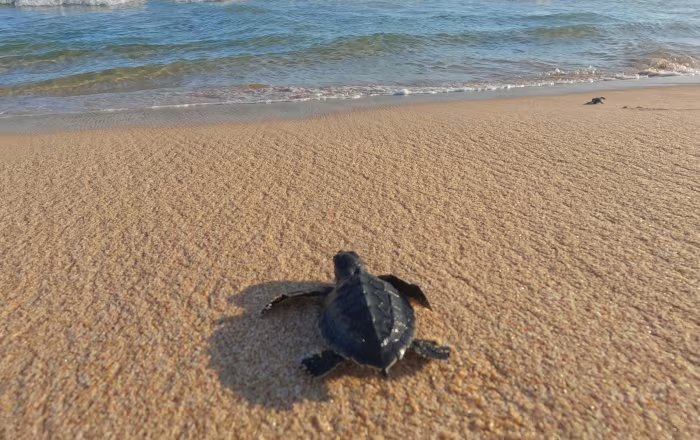
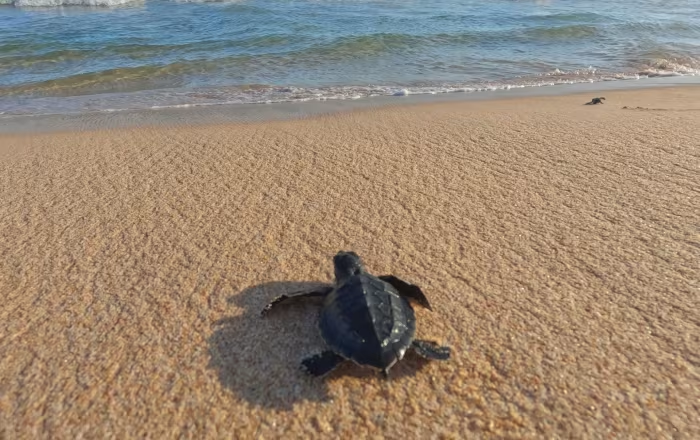
At the end of a turtle release, when the last hatchling has been pulled out by a wave, someone almost always asks the guide: how long will it live? It's a fair question, and the honest answer is more interesting than a single number. Sea turtles are long-lived animals, they take many years to grow up, and their real age is surprisingly hard to measure. Here's what is known about sea turtle lifespan, when each species starts nesting and what it means for the turtles of the Oaxacan coast.
The short answer
Sea turtles live for decades. For most species, scientists estimate a lifespan of roughly 50 years or more, and some, like green turtles and loggerheads, are thought to reach 70 or 80. But nobody knows the exact figure for any species, because almost no turtle has been followed from hatching to old age. What is better known is the age at which they start to breed, and that part of the story is long too: from about a decade for the fastest species to more than thirty years for the slowest.
Why is a turtle's age so hard to know?
A sea turtle's life is spent mostly out of sight. Hatchlings vanish into the open ocean for years, males almost never come ashore again, and females only appear on beaches once they're adults. Tags put on hatchlings are tiny and often lost, and the people who tag them may have retired by the time a turtle returns.
So researchers work backwards. They count growth layers in turtle bones, a bit like tree rings, from turtles found dead on beaches. They measure how fast tagged turtles grow between captures. And they compare turtles of known age in long-term studies. Each method has gaps, which is why you'll see ranges rather than exact numbers, and why claims of 150-year-old wild sea turtles should be taken with a grain of salt.
Lifespan and nesting age by species
Four species can be found along the coast of Oaxaca, plus the loggerhead, which is mostly an ocean visitor in this part of the Pacific. These are the figures given by NOAA Fisheries, the U.S. agency that studies sea turtles:
- Olive ridley. Reaches maturity at around 14 years. Nobody knows exactly how long it lives, but like other sea turtles it likely lives for decades. It's the species you release near Puerto Escondido, and one of the fastest to grow up.
- Leatherback. Grows faster than the hard-shelled species. Estimates of its age at maturity range from 9 to 20 years, and its life expectancy is thought to be 45 to 50 years or more.
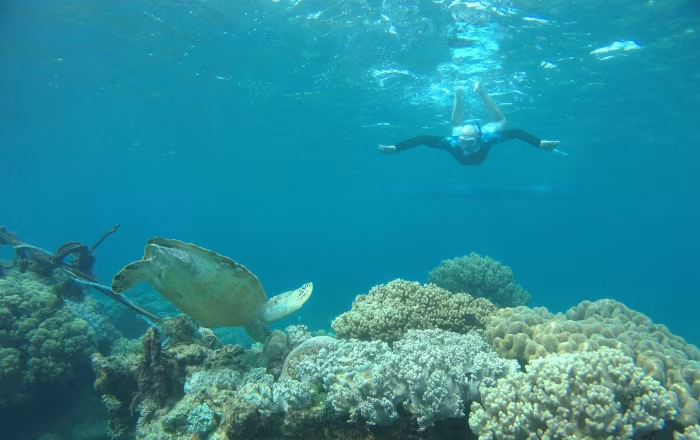
- Green turtle. Females reach maturity at 25 to 35 years, and green turtles could live 70 years or more. A slow grower on a diet of seagrass and algae.
- Hawksbill. Matures at 20 to 35 years, depending largely on how much food it finds, and is estimated to live 50 to 60 years.
- Loggerhead. Females reach maturity at about 35 years, and loggerheads can live 80 years or more.
If you want to tell these species apart in the water or on the sand, our guide to Oaxaca's sea turtle species covers what each one looks like and where to find it.
When do sea turtles start nesting?
A female nests for the first time once she reaches sexual maturity, so the ages above are also, roughly, the age of a first-time mother. Growth matters more than birthdays: a turtle that finds plenty of food matures sooner than one in poor feeding grounds, which is why the ranges are so wide.
Once she starts, a female keeps nesting for many years. Most species don't nest every season; leatherbacks usually skip two to four years between seasons, and green turtles two to five, while they rebuild the energy reserves that egg-laying takes. Olive ridleys are different. According to NOAA, they can nest every year, one to three times a season, with clutches of about 100 eggs. That steady output is one reason they can fill a beach like Escobilla during an arribada. Our olive ridley guide explains the mass nestings in more detail.
On this coast, olive ridleys nest mostly from June to January, with the busiest months usually between August and November. The hatchlings emerge about two months after each nest is laid, so releases continue all year. Our month-by-month season guide lays out the calendar.
What does this mean for the hatchling you release?
If the olive ridley you release this season survives and is a female, she would come back to nest around the early 2040s, give or take a few years. She could then keep coming back for a long time after that. Few hatchlings make it that far, and our post on how many baby sea turtles survive looks at the real odds without the scary myths. But the ones that do make it carry the population for many seasons.
The long wait to adulthood is the main reason conservation here is a long game. A nest protected today only becomes a new nesting female more than a decade later, so the effect of good or bad years on the beach shows up slowly. It also explains why losing adult females, to nets or poaching, hurts so much: each one took many years to replace.
What shortens a sea turtle's life?
Natural predators take most hatchlings and young turtles, but adults have few enemies besides large sharks and the occasional orca. For grown turtles, people are the main risk: accidental capture in fishing gear, boat strikes, plastic and lost nets, egg and meat poaching, and changes to nesting beaches. Rising sand temperatures add a slower pressure, since warmer nests produce more females and, past a point, fewer surviving eggs. We go through these one by one in what threatens sea turtles in Oaxaca.
A few quick answers
What is the oldest sea turtle on record?
There's no reliable record for a wild sea turtle's maximum age. Some captive turtles have lived for many decades, but life in an aquarium is very different from the open sea, so those ages don't translate well to wild turtles.
Do sea turtles stop nesting when they get old?
Researchers don't know of a clear "retirement" age. Tagged females have been seen nesting on the same coast for decades. What changes is mostly how often they nest, which depends on how much food they find between seasons.
Do turtles live longer than tortoises?
Some giant land tortoises are famous for living well over a century. For sea turtles, the evidence points to a lifespan of several decades, with the upper limit still unknown.
Where a female chooses to lay those eggs, decades after she hatched, is a story of its own. We explain it in do sea turtles return to the beach where they were born?