The East Pacific green turtle (tortuga prieta) in Oaxaca
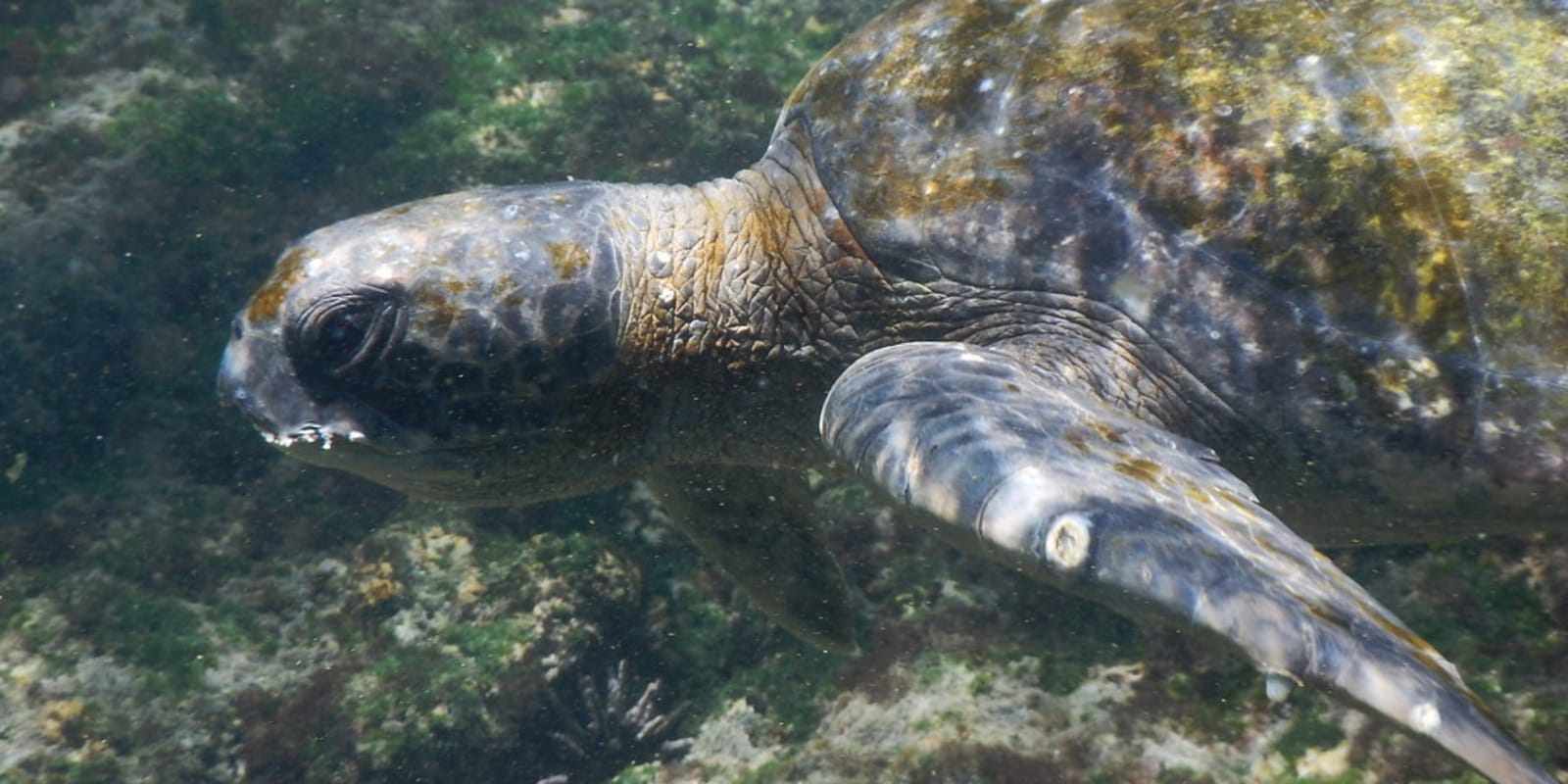
Cover photo, taken in the Galápagos: p.j.k. / Flickr, CC BY 2.0 (cropped).
Most turtle stories from this coast are about the olive ridley, the small turtle that arrives by the thousands at La Escobilla. It has a darker, heavier neighbor that gets far less attention: the East Pacific green sea turtle, known in Mexico as the tortuga prieta or tortuga negra, the black turtle. It grazes in coastal waters, nests on some Oaxacan beaches and has been through one of the sharpest collapses, and recoveries, of any turtle in the country.
What is the East Pacific green sea turtle?
It is the Eastern Pacific form of the green turtle, Chelonia mydas, found from Mexico south to Peru and the Galápagos. Scientists have argued for years over whether it deserves its own name. You will see it written as a separate species, Chelonia agassizii, a name Mexico's official list of species at risk has used, or as a subspecies. Most international bodies treat it as a population of the green turtle.
The name "green" is confusing when the animal in front of you looks almost black. It comes from the color of the fat under the shell, not from the shell itself.
How to recognize a tortuga prieta
- Color: adults usually look dark gray to black from above, often with streaks or rays of brown and olive. The underside is much paler.
- Size: clearly bigger than an olive ridley, although smaller than the green turtles of the Atlantic and Caribbean.
- Head: short and rounded, with a single pair of large scales between the eyes and the nose. Olive ridleys and hawksbills have two pairs.
- Shell: smooth and roughly heart-shaped, with four large plates down each side and a noticeable notch toward the back.
An olive ridley, by comparison, is small, with a rounder olive-gray shell and more side plates. Our guide to the sea turtle species of Oaxaca puts the species side by side, and the olive ridley guide covers the one you are most likely to meet.
A turtle that grazes
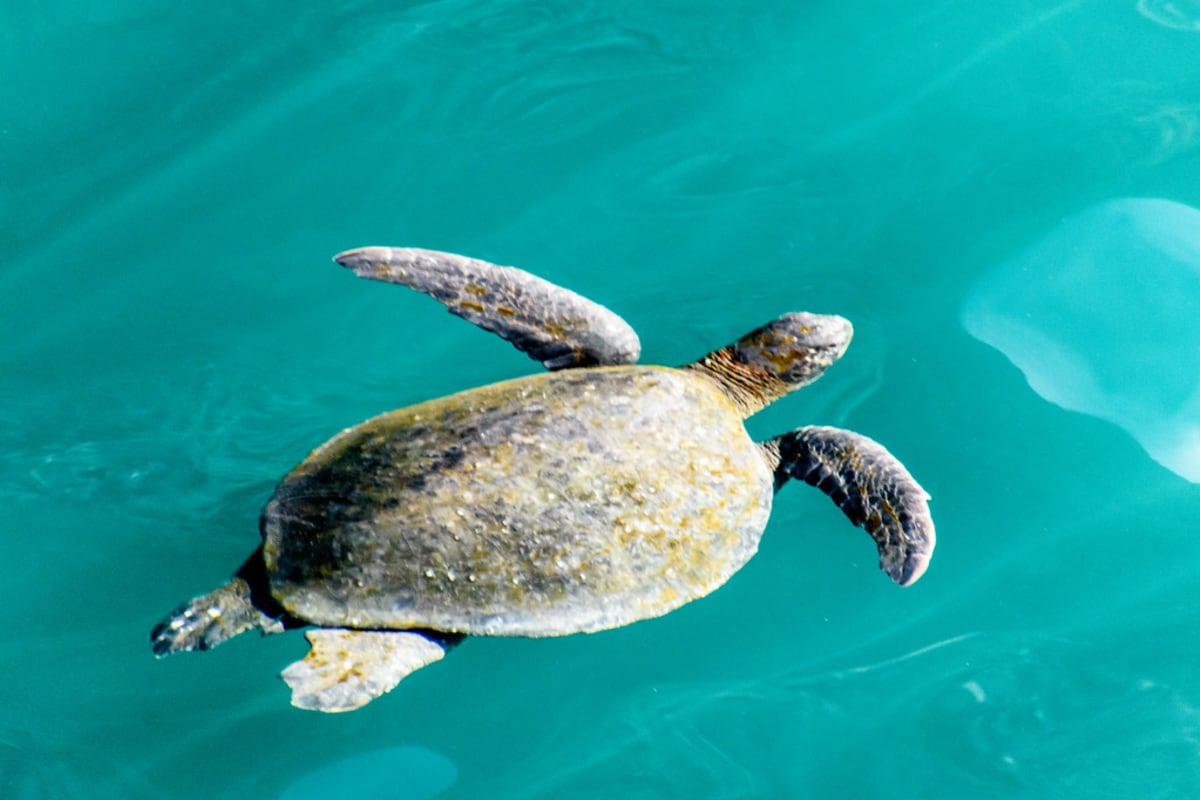
Young green turtles eat a bit of everything. Adults turn mainly to plants: algae and seagrass, cropped with a broad, serrated jaw. The East Pacific population is known for eating more animal food than other green turtles, so "vegetarian" is a good summary rather than a strict rule. That diet keeps it close to shore, in bays, lagoons and rocky coasts where there is something to graze. The lagoons known as Laguna Superior and Laguna Inferior, on Oaxaca's side of the Isthmus of Tehuantepec, have long been listed among its feeding grounds.
Where and when it nests
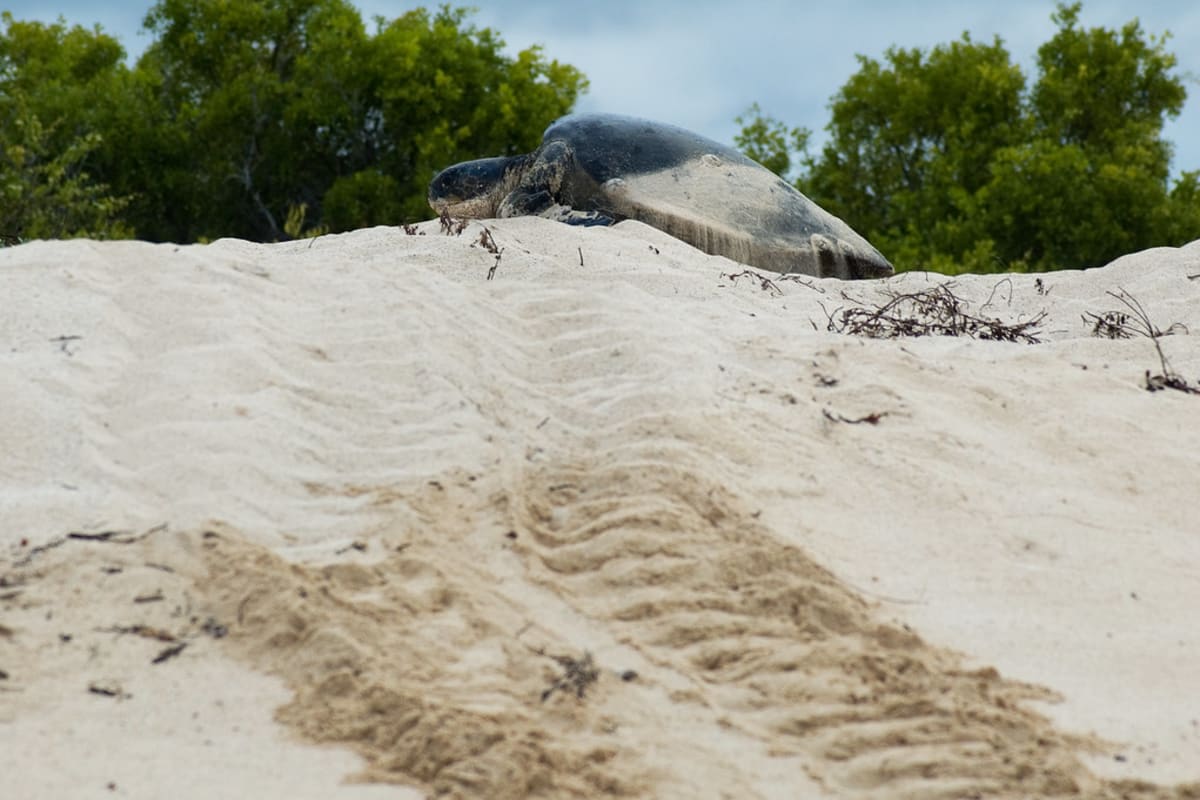
The heart of the population's nesting in Mexico is not in Oaxaca but in Michoacán, above all on the beaches of Colola and Maruata. On the Pacific mainland the season runs roughly from August to January, with the peak in October and November. Females usually come ashore at night, on their own rather than in mass arrivals, and lay several clutches in a season about two weeks apart. Then most of them wait two years or more before nesting again. The general process is the same one we describe in how sea turtles lay eggs.
And in Oaxaca?
Nesting here is much more modest, but it is real. The federal management program for the Santuario Playa Chacahua (in Spanish), west of Puerto Escondido, ranks the tortuga prieta as the second most frequent nester there, after the olive ridley and ahead of the leatherback. Older surveys describe nesting on other Oaxacan beaches as sporadic. Turtles tagged while nesting in Michoacán have also been recaptured off Oaxaca, so some of the dark turtles in these waters may be travelers.
Will you release a tortuga prieta on a tour?
Do not count on it. The evening release near Puerto Escondido takes place with hatchlings from Playa Escobilla, which are almost always olive ridleys and occasionally leatherbacks. A prieta is more likely to be seen in the water, surfacing for a breath near rocks or from a boat, and even that is a matter of luck. If you do see one, keep your distance and let it carry on feeding; we explain why in our note on swimming with sea turtles in Puerto Escondido.
Collapse and recovery
From the 1960s, eggs and adults from this population were taken on a commercial scale. In the early 1970s something like 70,000 eggs a night were being removed from Colola during the season, and thousands of turtles were caught each year for meat and skin. According to CONANP's species sheet (in Spanish), nesting females counted at Colola fell from about 2,500 in 1981 to just 171 in 1999.
Protection of the nesting beaches, with local communities closely involved, and Mexico's permanent ban on taking sea turtles in 1990 helped change the direction. Researchers writing for The State of the World's Sea Turtles report about 86,000 nests at Colola in the 2021–2022 season, laid by an estimated 28,000 females, and note increases in other states, Oaxaca among them.
Is it still endangered?
It depends on which list you read. The IUCN moved the green turtle as a whole to "Least Concern" in 2025, but it rates the East Pacific population separately, as "Vulnerable". In Mexico the official standard, NOM-059-SEMARNAT-2010, classes it as in danger of extinction, and taking the turtles or their eggs is illegal. Egg poaching, hunting, accidental capture in fishing gear and the loss of nesting beaches to development have not gone away. For the local picture, see what threatens sea turtles in Oaxaca.
What a visitor can do
Do not buy turtle eggs, meat or shell products. On a night beach, keep lights and flash off and never approach a nesting female. In the water, do not touch, chase or feed any turtle. And if you are planning a trip around nesting season, our month-by-month guide to turtle season in Oaxaca shows what usually happens when.