Why are baby turtles released at sunset?

Ask anyone who has done a turtle release in Puerto Escondido what they remember and you will probably hear about the sky. The timing looks as if it was chosen for the photos. There are better reasons than that, but there is also a limit worth knowing: the hatchlings' needs come before the schedule, not the other way round.
The short answer
A turtle release happens around sunset because conditions on the beach are gentler for the hatchlings then:
- The sand has started to cool. At midday it can be hot enough to overheat and dry out a hatchling before it reaches the water.
- The light is fading. Predators that hunt by sight, such as many birds, have a harder time as it gets dark.
- It is close to when nests often hatch on their own. Hatchlings tend to come to the surface when the sand cools, usually in the evening or at night.
None of this makes sunset a magic hour. It is a sensible window, not a guarantee that a given turtle will make it.
Cooler sand matters more than it seems
A hatchling is small enough to sit in your palm, and it crosses the beach on its belly and flippers. Dark sand under a high sun heats up fast, as you will know if you have tried walking on it barefoot at two in the afternoon. A turtle that has to crawl across that surface loses water and strength it needs for the sea.
It also leaves the nest with a limited reserve of energy from the yolk. That fuel has to carry it down the beach, through the breakers and into a long stretch of nearly nonstop swimming. Heat, long waits and extra handling all draw on the same account.

Fewer eyes, but not zero
Birds, crabs, dogs and, in the water, fish all eat hatchlings. Low light helps against some of them, mainly those that spot prey from the air. Crabs and fish do not clock off at dusk, so the danger never drops to nothing. For a realistic picture of what comes next, read how many baby sea turtles survive.
Light: the part people can ruin
Hatchlings find the sea mostly by heading toward the brightest, lowest horizon, which on a natural beach is the open sky over the water. At dusk that glow usually still stands out against the darker land behind. A phone flashlight, a camera flash or a lit window can compete with it and send a turtle the wrong way. The full story, including waves and magnetism, is in how baby sea turtles find the ocean.
This is why the tour does not allow flash. Switch it off before you leave your hotel, and see our turtle release photography tips for getting the shot with natural light.
Should hatchlings be kept waiting for sunset?
No. This is the part that is often left out. Mexico's official standard for protecting sea turtles on their nesting beaches, NOM-162-SEMARNAT-2012 (in Spanish), says hatchlings from a protected hatchery must be released with minimal handling, as soon as they have come to the surface and are active, which takes about an hour on average. They are carried in a dry container to the wet sand, then left to walk into the sea without help.
The standard only allows hatchlings to be held back in specific cases: they have not finished developing, there is extreme weather such as a storm or hurricane, or there is temporary contamination. A visitor schedule is not on that list.
So the honest version is this: an evening release makes sense when the natural timing of an emergence and good conditions on the beach line up. A nest that comes up early in the morning should not sit in a tub until a group arrives. And on some days there are fewer hatchlings than people hoped for, because the number depends on what actually hatched.
Sunset in Puerto Escondido moves through the year
On our tour, pickup is at 4:30 PM, there is a hatchery visit at Playa Escobilla around 5:00 PM, the release follows at about 5:30 PM and you are back at your hotel by about 7:00 PM. The sun keeps its own timetable: it sets around 6 PM from late November to January, and closer to 7 PM in June and July. In winter the release happens in low orange light; in summer the sun is still above the horizon and the light is bright. If a golden sky matters a lot to you, that is worth knowing before you book.
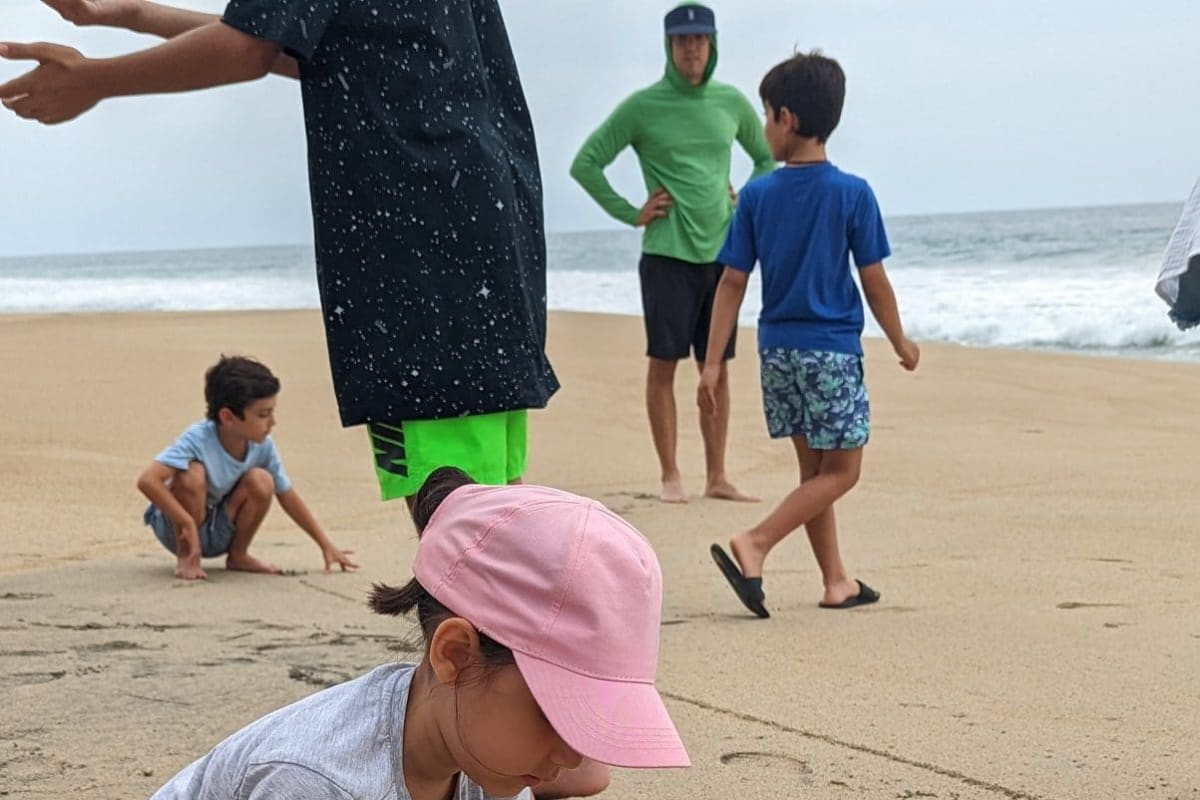
How to be a good guest at a release
- Follow your guide on where to stand and when to move.
- Keep your hands free of sunscreen, lotion and insect repellent. The same standard requires it of the hands that release hatchlings.
- Stay behind the turtles, at least two metres back, and watch your feet.
- No flash and no flashlight.
- Let them walk. Do not carry them into the waves or nudge them along, even if one pauses.
If you want to judge a program, ask one simple question: when did these hatchlings come out of the nest? A good team will know and will tell you.
For what to wear and how to plan the evening, continue with our tips for families and first-timers.


